
Free Keyword Research Tools: Best Free Tools to Find Easy Keywords in 2026
Introduction If you want to grow your website traffic, start a blog, rank on Google, or improve your SEO strategy, free keyword research tools…
Introduction
If you want to grow your website traffic, start a blog, rank on Google, or improve your SEO strategy, free keyword research tools can help you find the right keywords faster and more easily.
These tools help you discover what people search for online. They show keyword ideas, search volume, competition level, and trending topics.
The good news?
You do not need expensive SEO software to get started.
Many free keyword research tools are powerful enough for bloggers, affiliate marketers, freelancers, YouTubers, and small business owners.
In this guide, you will learn:
- What free keyword research tools are
- Why keyword research matters
- The best free keyword research tools in 2026
- How to use these tools correctly
- Common mistakes to avoid
- FAQs people search on Google
Let’s get started.
Why Keyword Research Is Important
Before creating content, you need to know what people are searching for.
Without keyword research, your articles may never appear on Google.
Free keyword research tools help you:
- Find popular search terms
- Discover low-competition keywords
- Understand search intent
- Get blog post ideas
- Improve SEO rankings
- Increase organic traffic
For example, instead of targeting a difficult keyword like:
- “SEO”
You may find easier keywords like:
- “free keyword research tools for beginners”
- “best SEO tools for bloggers”
- “how to find low competition keywords”
These keywords are easier to rank for.
That is why smart keyword research matters.
What Are Free Keyword Research Tools?
Free keyword research tools are online platforms that help users find keyword ideas.
These tools collect search data from Google and other search engines.
They show information like:
- Monthly search volume
- Keyword difficulty
- Related keywords
- Search trends
- Questions people ask
- Competition level
SEO experts use free keyword research tools to plan content and improve rankings.
Even beginners can use these tools easily.
Best Free Keyword Research Tools in 2026
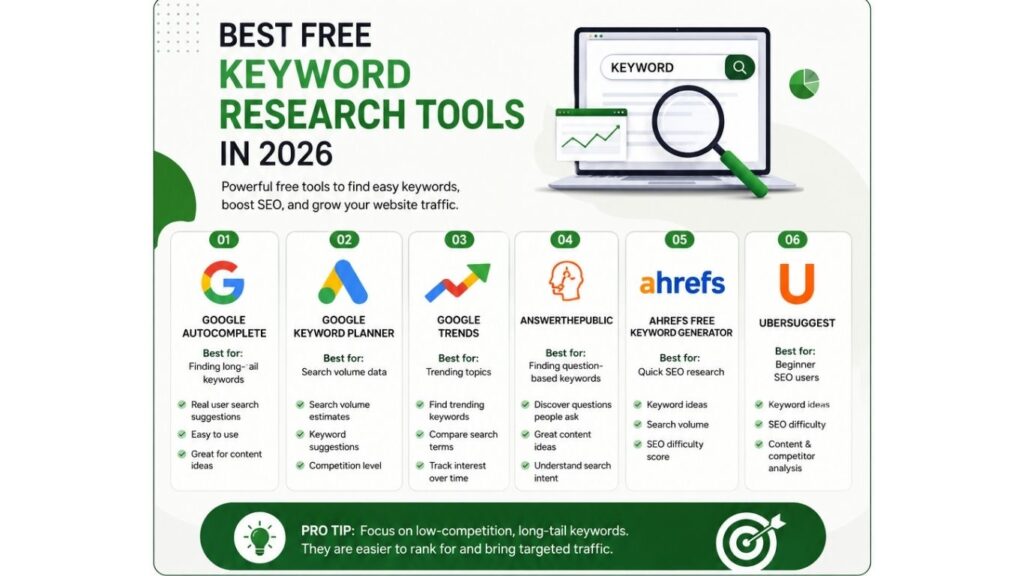
1. Google Autocomplete
Best for: Finding long-tail keywords
Google Autocomplete is one of the easiest free keyword research tools.
When you type something into Google search, Google automatically shows suggestions.
These suggestions come from real user searches.
Example:
If you type:
“free keyword research…”
Google may suggest:
- free keyword research tools
- free keyword research tools for SEO
- free keyword research tools for YouTube
- free keyword research tools for beginners
Benefits
- Completely free
- Real search data
- Great for content ideas
- Easy for beginners
2. Google Keyword Planner
Google Keyword Planner is one of the most popular free keyword research tools.
It was created for advertisers, but SEO professionals also use it for keyword research.
Features
- Search volume estimates
- Keyword suggestions
- Competition level
- PPC keyword data
Benefits
- Free to use
- Reliable Google data
- Good for SEO planning
- Helpful for beginners
3. Google Trends
Best for: Trending topics
Google Trends helps users discover trending searches.
It shows how search interest changes over time.
This is one of the best free keyword research tools for finding seasonal topics and rising trends.
Benefits
- Find trending keywords
- Compare search terms
- Discover seasonal content ideas
- Track audience interest
4. Answer The Public
Best for: Finding question-based keywords
AnswerThePublic shows questions people ask online.
This makes it one of the most useful free keyword research tools for blog writers.
Example Questions
- What are free keyword research tools?
- Which keyword tool is best for SEO?
- How do beginners find keywords?
Benefits
- Great content ideas
- Understand audience questions
- Improve topical authority
- Easy to use
5. Ahrefs Free Keyword Generator
Best for: Quick SEO research
Ahrefs offers a free keyword generator tool that gives keyword suggestions and SEO difficulty scores.
Many marketers use it because it is simple and fast.
Features
- Keyword ideas
- Search volume
- Difficulty score
- Related keyword suggestions
Benefits
- Beginner-friendly
- Fast results
- Helpful for SEO blogs
- Good keyword suggestions
6. Ubersuggest
Best for: Beginner SEO users
Ubersuggest is another popular platform among free keyword research tools.
It provides:
- Keyword ideas
- SEO difficulty
- Content ideas
- Competitor analysis
Benefits
- Clean dashboard
- Easy to understand
- Good for beginners
- Helpful SEO reports
How to Use Free Keyword Research Tools Correctly
Many beginners use free keyword research tools the wrong way.
They only focus on high search volume.
That is a mistake.
Here is the smart way to use these tools.
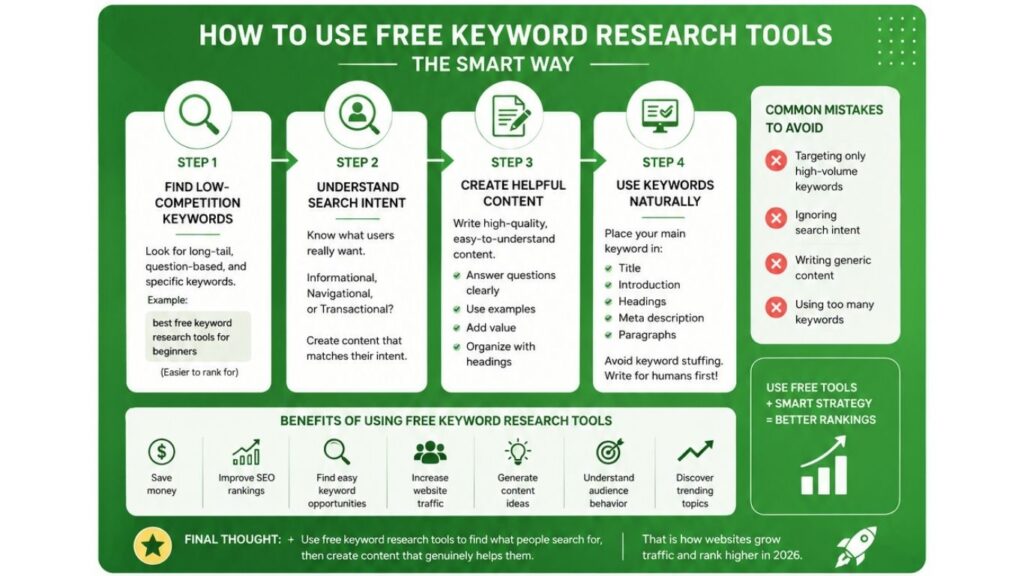
Step 1: Find Low-Competition Keywords
Do not target highly competitive keywords at the start.
Instead, look for:
- Long-tail keywords
- Beginner-friendly keywords
- Problem-solving searches
- Question-based searches
Example:
Instead of targeting:
- “SEO tools”
Target:
- “best free keyword research tools for beginners”
This is easier to rank for.
Step 2: Understand Search Intent
Search intent means understanding what users want.
For example:
Someone searching:
- “buy laptop online”
wants to purchase something.
Someone searching:
- “best laptops for students”
wants information.
Free keyword research tools help you understand this intent.
Step 3: Create Helpful Content
Google ranks content that helps users.
Do not just stuff keywords everywhere.
Instead:
- Answer questions clearly
- Use simple language
- Add examples
- Break content into sections
- Use headings properly
Helpful content performs better.
Step 4: Use Keywords Naturally
Use your main keyword naturally in:
- Title
- Introduction
- Headings
- Meta description
- Paragraphs
But avoid keyword stuffing.
Your article should still sound natural.
Common Mistakes to Avoid
Here are common mistakes people make while using free keyword research tools.
1. Targeting Only High-Volume Keywords
Big keywords are usually harder to rank for.
Small websites should focus on low-competition keywords first.
2. Ignoring Search Intent
If your content does not match user intent, rankings will drop.
Always understand what users actually want.
3. Writing Generic Content
Many websites publish the same information.
Try to create better and more useful content.
4. Using Too Many Keywords
Keyword stuffing makes content difficult to read.
Write naturally.
SEO should help readers, not confuse them.
Benefits of Using Free Keyword Research Tools
Free keyword research tools offer many advantages.
Benefits
- Save money
- Improve SEO rankings
- Find easy keyword opportunities
- Increase website traffic
- Generate content ideas
- Understand audience behavior
- Discover trending topics
These tools are especially helpful for:
- Bloggers
- Small businesses
- Affiliate marketers
- Freelancers
- YouTubers
- SEO beginners
FAQs About Free Keyword Research Tools
What are the best free keyword research tools?
Some of the best free keyword research tools include:
- Google Keyword Planner
- Google Trends
- Google Autocomplete
- Ahrefs Free Keyword Generator
- AnswerThePublic
- Ubersuggest
Are free keyword research tools good for SEO?
Yes. Many free keyword research tools are powerful enough for beginners and small websites.
They help users discover keywords, trends, and content opportunities.
Which free keyword research tool is best for beginners?
Google Keyword Planner and Ubersuggest are great for beginners because they are easy to use.
Can I do keyword research without paid SEO tools?
Yes. Many successful bloggers use free keyword research tools before investing in premium software.
How do I find low-competition keywords?
Use free keyword research tools to search for:
- Long-tail keywords
- Question-based keywords
- Specific search phrases
These keywords are often easier to rank for.
How often should I do keyword research?
Keyword research should be done regularly.
Search trends change over time, so updating your keyword strategy is important.
Final Thoughts
Free keyword research tools are extremely useful for anyone starting SEO.
They help you find keywords, understand search trends, and create better content.
But tools alone are not enough.
To succeed in SEO, you also need:
- Helpful content
- Clear writing
- Smart keyword strategy
- Understanding of user intent
The best approach is simple:
Use free keyword research tools to discover what people search for.
Then create content that genuinely helps them.
That is how websites grow traffic and rank higher on Google in 2026.